


Introduction
In a world shaped by overlapping crises—political, ecological, economic, and spiritual—the ways we gather matter as much as what we gather for. Meetings, workshops, community circles, and coalitions are not neutral spaces; they are sites where power is either hoarded or shared, where people are either extracted from or tended to. Facilitation for the Future asks a simple but profound question: How do we design and hold spaces that share power with, rather than exert power over?
Through our work in Culture Tending Collective and our recent workshop on Facilitation for the Future, we’ve been exploring a (a) meta-structure that can apply to almost any kind of gathering: (b) opening, (c)orientation, (d) main course, and (e) closing, with intentional (f) pre-work and (g) debrief wrapped around the whole thing. Within this structure, we look at how culture, access, racial equity, and organizational realities intersect and interact—because the way you open a space, the information you share ahead of time, the choices you make about who speaks and how decisions get made, all quietly answer the question: Who is this space really for?
What emerged from the workshop, in conversation with participants, is not a rigid methodology but a set of principles—living practices—for facilitators who want to tend culture, redistribute power, and design gatherings that are more aligned with our missions, visions, and values. This article shares those principles and offers a framework for anyone who is asking: How can my facilitation help communities not just survive the present, but practice the futures we long for?
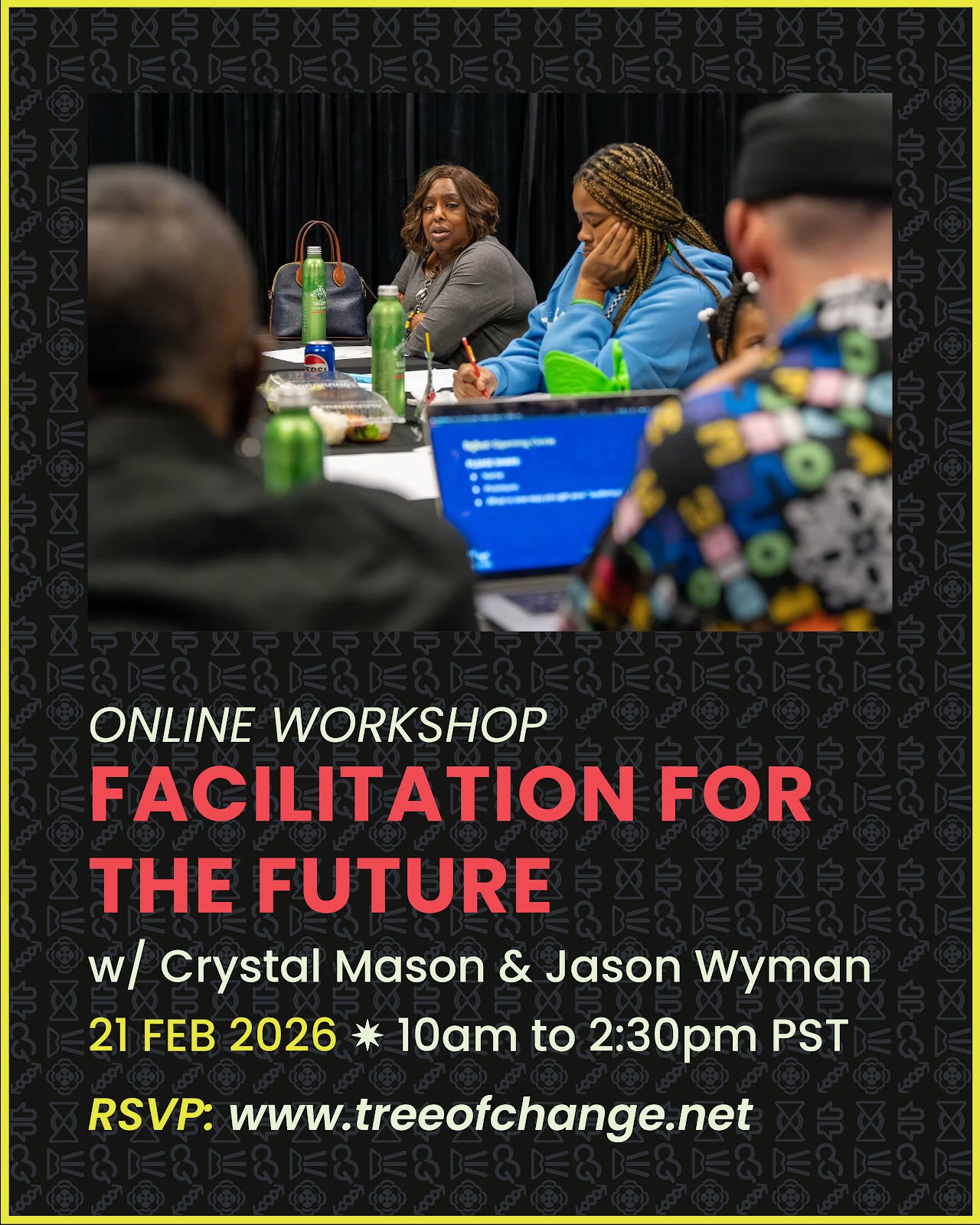
Principles for Facilitation for the Future
(A) Meta-Structure
Slow Down to Go Far
Urgency is a tool of domination. Slowing down builds collective clarity, distributes leadership, and reduces rework.
Practices:
Protect spaciousness for reflection
Avoid overpacked agendas
Trust that relational time supports more effective action later
Facilitation Is Shared — Not Solely the Facilitator’s Job
While facilitators guide the container, power is held collectively.
Everyone contributes to maintaining agreements, culture, and care.
Practices:
Name roles clearly
Invite shared responsibility for holding the space
Ask participants to support one another in staying aligned with agreements
Maintain the Integrity of the Circle
Not every space is for everyone. Protecting the health of the container is more important than accommodating disruptive or harmful behavior.
Practices:
Address harm early
Center the safety and dignity of the group
Use agreements as a compass, not decoration
Remember: accountability is a form of care
Honor Emotion, Body, and Spirit as Sources of Wisdom
People do their best thinking when their nervous systems feel regulated and respected.
Practices:
Use somatics, grounding, or breath
Acknowledge emotional responses as valid
Make room for the human, not only the task
(B) Opening
Open with Intention, Not Urgency
How you begin a gathering shapes everything that follows. Strong openings create grounding, connection, and clarity — the antidotes to rushing, confusion, and power-over dynamics.
Practices:
Allow arrival time
Offer check-ins or grounding
Make space for people to land as themselves
(C) Orientation
Orient People Toward Shared Purpose and Shared Power
People need to know where they are, how decisions get made, and what agreements hold the space. Clarity diminishes harm and increases belonging.
Practices:
Present or co-create agreements
Name decision-making processes
Provide simple tools for addressing harm (e.g., Ouch/Oops)
Share values, positionality, and context
(D) Main Course
Design With — Not For — the People in the Room
Accessibility, rhythm, pacing, and logistics are not neutral. They are political choices that determine who can meaningfully participate.
Practices:
Consider access (physical, emotional, economic, cultural)
Choose time, space, and pacing based on who you are gathering
Ask what participants need to feel included, safe enough, and in their power
(E) Closing
Close with Care and Transition
Closings help people integrate what happened, return to themselves, and re-enter the wider world with intention.
Practices:
Offer reflection, harvest, or meaning-making
Clarify next steps
Celebrate contributions
Acknowledge the shift from the container back into daily life
(F) Pre-Work
Practice Transparent Information Sharing
Information hoarding is a tool of power-over. Transparency builds trust, shared understanding, and collective decision-making capacity.
Practices:
Share agendas, notes, timelines, and expectations
Name constraints and context
Document decisions and make them accessible
(G) Debrief
Design for Continual Becoming
Facilitation is a growth practice — for the facilitator and the group. Groups evolve. Culture evolves. We evolve.
Practices:
Reflect on what worked and what didn’t
Adjust pacing and structure as needs change
Invite feedback
Remain open, curious, and willing to shift
The question of who a space is really for stayed with me. I’ve felt how much the way we open and hold gatherings quietly answers that before anything else happens. I appreciate how you frame facilitation as a living practice — about tending culture and sharing power, not just managing space. That invitation to practice the futures we long for feels essential right now.